Same intelligence. Different needs. Different product decisions.
Over the past two months, taking Ryme into real-world use cases has revealed something I hadn't fully anticipated: the same intelligence can serve very different needs, but the product around it has to change.
Ryme started by helping founders prepare for important conversations. Through its use across different communities, two additional directions began to emerge: Ryme Judge and Ryme for Builders.
Both involve understanding a project, examining evidence, and identifying strengths and gaps. But their purposes are fundamentally different.
Judges need consistent criteria, structured evaluations, and evidence to support decisions across multiple submissions.
Builders need to understand what they've accomplished, what they might have overlooked, and what to do next. A score alone isn't particularly useful.
The underlying intelligence stays consistent. The experience changes with the context.
What Comes After the Prototype?
AI coding tools are changing what can happen in just a few hours. At Berkeley Women Hack Night, the build window was roughly two hours, yet even first-time vibe coders produced impressive projects.
But the ability to create a working demo doesn't answer the questions that determine whether it could become a viable product.
Who actually needs it? What makes it different? Can someone unfamiliar with the project use it? What happens outside the happy path? Which assumptions remain untested?
Not every prototype needs to become a product. Experimentation and learning are valuable outcomes in their own right.
But for those who want to go further, particularly first-time builders, the challenge is often knowing which questions to ask before knowing how to answer them.
That's the opportunity I'm exploring with Ryme for Builders: helping people identify what they've validated, what remains uncertain, and which problems they need to address next.
Not another scoring tool. A way to develop better product judgment.
Architecture Is a Product Decision
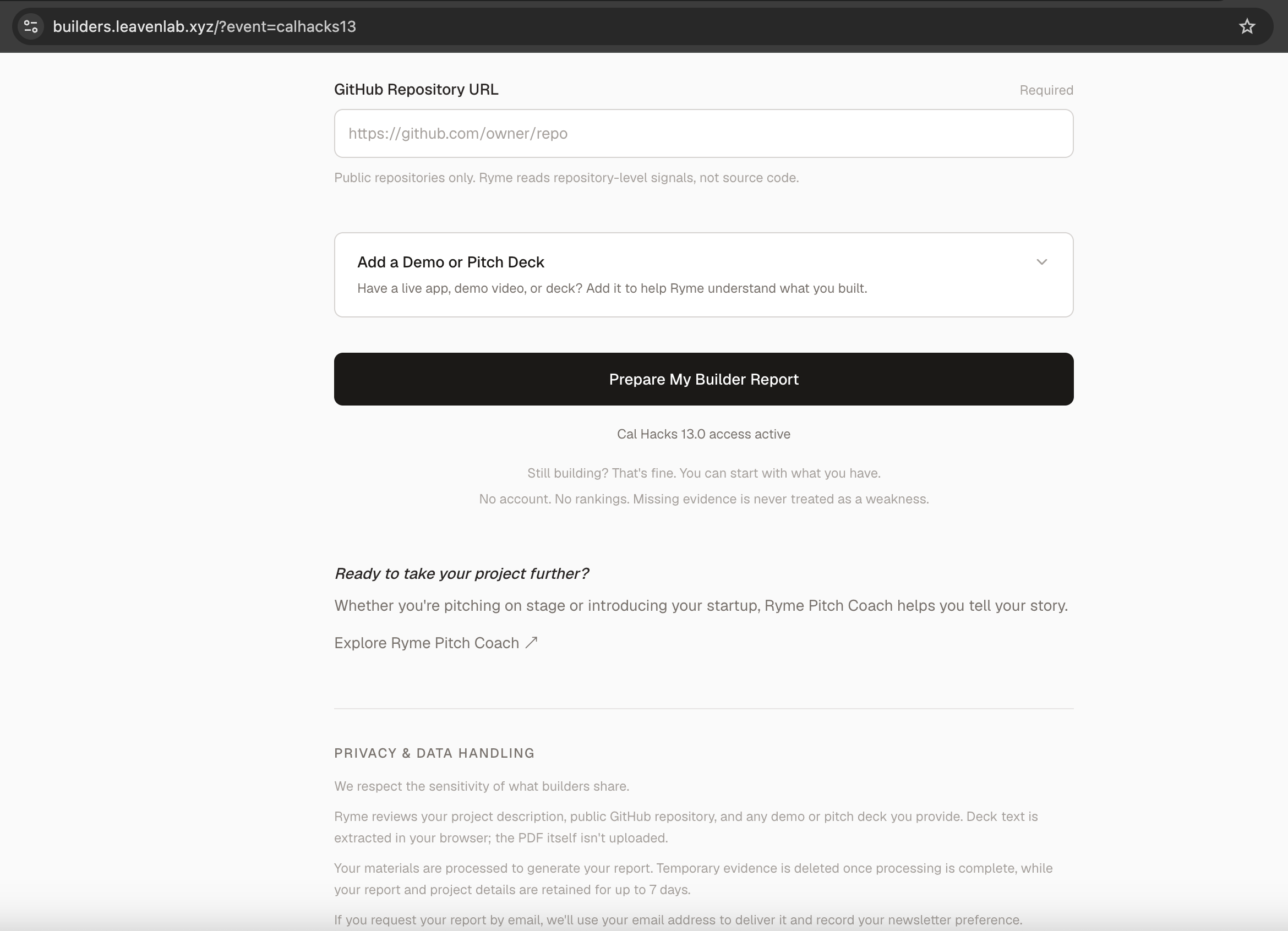
Cal Hacks 13.0 brought this thinking into my own development process.
I built a dedicated Ryme for Builders entry point, with an architecture designed for the possibility of concentrated demand from a large hackathon. Each analysis involves retrieving project materials, examining repository evidence, and generating feedback.
The obvious engineering challenge was concurrency. But the more useful question was: Does every submission need to be processed immediately?
No.
For this use case, builders can submit their projects and receive feedback asynchronously. A queue-based architecture allows incoming submissions to be handled separately from resource-intensive analysis, with processing capacity kept under control rather than scaled to every simultaneous request.
That decision also shapes the experience.
Judges reviewing a batch may need visibility into evaluation progress. Individual builders don't need to see how many submissions are ahead of them. They need confirmation that their project has been received and a clear way to access the result.
Actual usage at Cal Hacks wasn't high enough to test the system under significant load, so the scalability assumptions remain unproven. But the architectural choices were made in advance, based on what the experience actually required.
I'm building Ryme with AI coding tools myself. Implementation is getting faster, but decisions about constraints, trade-offs, and experience still have to be made deliberately.
Scaling isn't always about making everything faster. Sometimes it's about knowing what doesn't need to happen at the same time.
When Capabilities Start to Look Alike
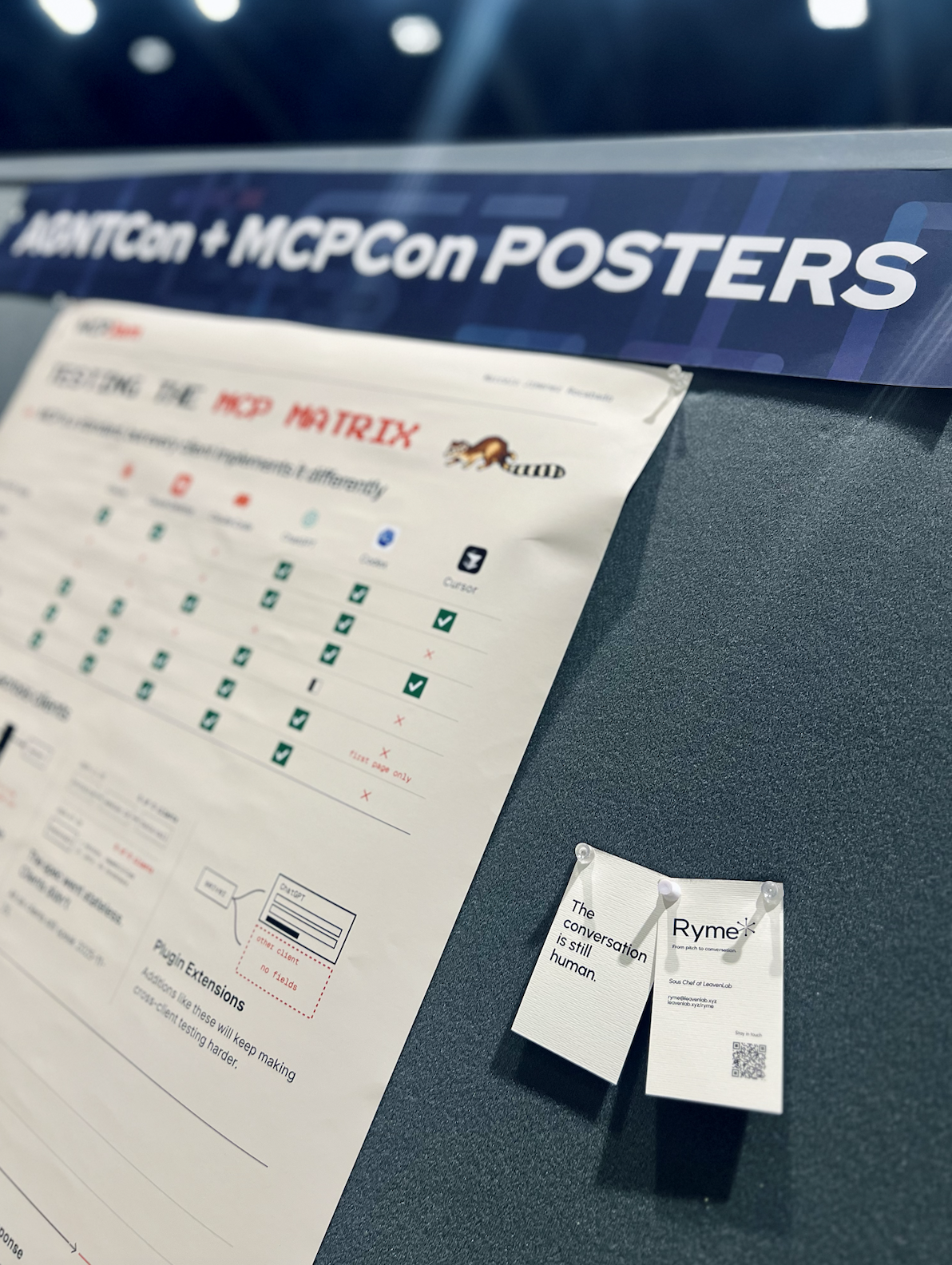
At MCPCon, I was struck by how similar many agent infrastructure products sounded on the surface.
Different companies described overlapping capabilities and seemingly similar solutions. I kept asking: What actually makes this product different? Why would someone choose it over the alternatives?
Some founders acknowledged the same challenge.
Technical differences may exist beneath the surface, but they don't automatically translate into meaningful differentiation for users.
As AI development tools and agent infrastructure become more accessible, implementing a capability is increasingly just the starting point.
What matters is choosing a problem worth solving, understanding who needs it, and making the experience genuinely useful and seamless.
That requires human judgment, not just technical execution.
Beyond the Capability
The more Ryme moves across different use cases, the clearer this distinction becomes.
A shared intelligence layer makes it possible to address different problems without starting from scratch. But knowing where that intelligence belongs, what it should deliver, and how it should fit into someone's workflow is a separate design challenge.
For Ryme, that means the next stage isn't simply about expanding what the system can analyze. It's about making the intelligence useful in more specific moments, for different people, with different expectations.
The capability creates possibilities. The experience determines which of them become valuable.