⏳ The long proof #1: when building gets cheap, responsibility gets expensive
What seven weeks of building Ryme taught me about product value, user trust, and maintaining AI systems
Ryme grew out of patterns I had been observing over time.
I had seen startup storytelling from two sides: first as a founder myself, and later through venture and accelerator work. In recent years, I became increasingly involved in evaluating early-stage companies through accelerator selection processes, venture work, pitch competitions, and judging or selection committees.
The more companies I saw, the more I began to notice patterns that were not always visible in a single pitch, but became clearer across many of them.
A pitch problem was often not really a writing or slide-design problem. What looked like a weak sentence, an unclear slide, or a presentation issue was often pointing to something deeper: a gap in positioning, business logic, fundraising readiness, or the founder’s understanding of how the opportunity would be evaluated.
Over time, those observations crystallized into a methodology.
Ryme is my attempt to make that methodology more accessible—not limited to a single meeting or one-on-one conversation, but available to founders when they are preparing on their own.
The first working version took only a few hours to build. Vibe coding allowed me to turn that methodology into a testable product workflow in one afternoon.
But the speed of the build was not the source of its value.
The interface took an afternoon. The judgment inside it came from years of working on both sides of the table.
One of the first founders to try Ryme was preparing for an upcoming pitch event. The feedback helped with the preparation in ways the founder had not anticipated. They later reached out specifically to say that Ryme should become a commercial product—one that could help many more founders.
That early response made me continue.
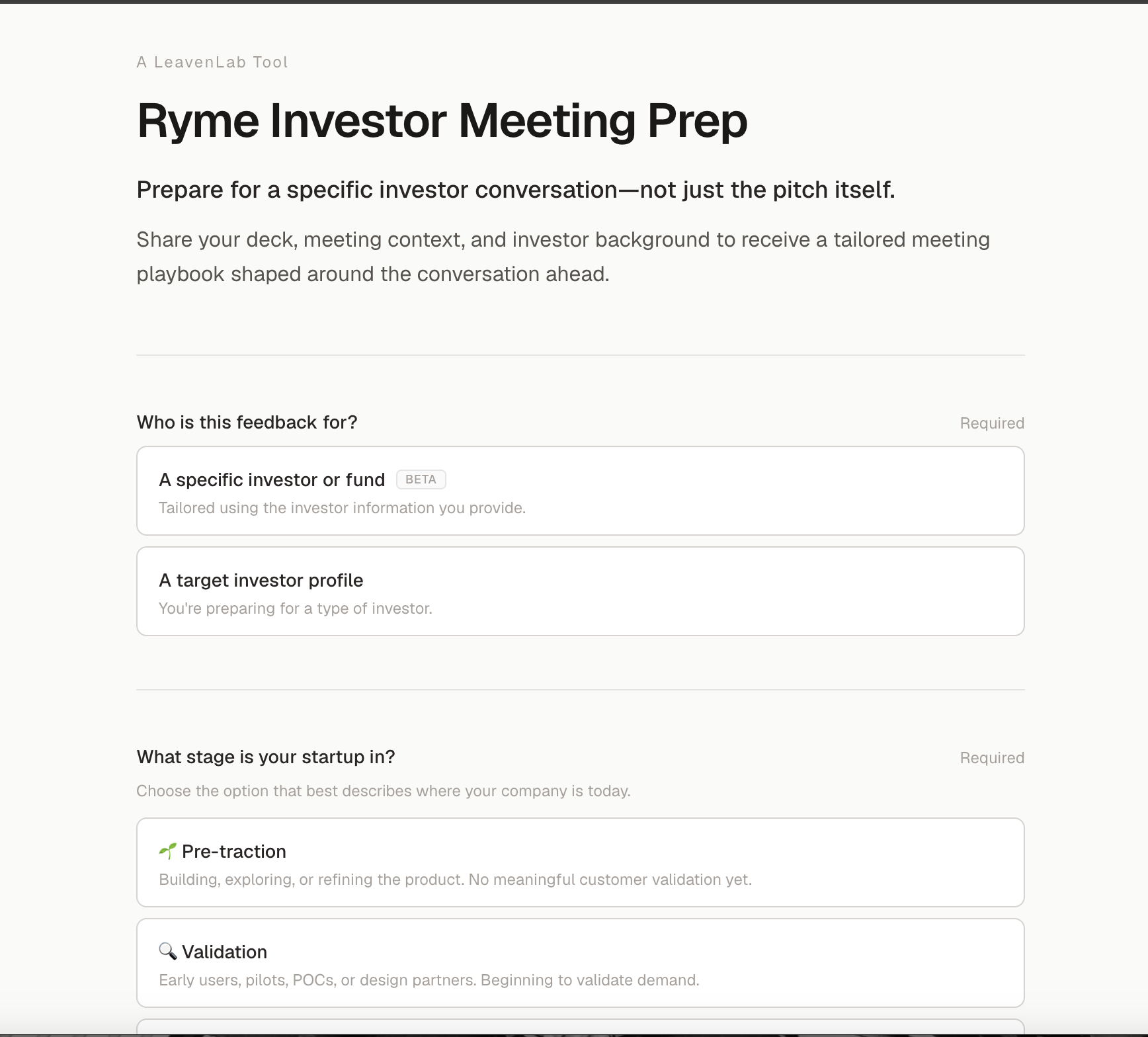
Over the next seven weeks, I added email reports, deeper analysis, access controls, payment flows, and a second workflow for investor meeting preparation.
At the same time, I was seeing more AI skills, prompts, workflows, and agent configurations being shared or sold on social media. Open-source versions of many workflows were also becoming easier to find.
That does not mean these skills are interchangeable.
Two tools may both claim to help with pitching or storytelling while reflecting very different levels of experience, judgment, and context. The quality of a skill depends on what has been crystallized into it: generic advice, or patterns developed through years of building a startup, working closely with founders, and evaluating companies across venture and accelerator settings.
That distinction is part of Ryme’s value.
But it also led me to a broader question:
If the technical form of a skill can be purchased, copied, or built quickly, what turns valuable judgment into a finished product?
Part of the answer is the quality of the experience and methodology inside it.
The other part is whether the product can deliver that judgment safely and reliably enough to earn a user’s trust.
Lesson One: When implementation gets cheap, responsibility gets expensive
Early in my career, I was a co-founder of a real-time AI startup. I was the non-technical one, but that experience shaped how I think about data and privacy: what a product genuinely needs to collect, what it only needs to process, and what it should not retain simply because it is technically possible.
Those questions matter with Ryme because founders may ask the product to process unpublished decks, fundraising plans, startup information, and strategic assumptions.
The question is not only whether the product can generate a useful report.
It is also:
Why should someone trust the product to process this information?
Security is often treated as a technical layer added after a product is built. From the user’s perspective, however, security is part of the product itself.
A working oven is not necessarily ready to be installed in a commercial kitchen.
The first working prototype of Ryme took two or three hours to build. Security hardening alone took at least two full days.
That contrast stayed with me.
A prototype only needs to prove that its core mechanism works. A product serving real users also needs clear data boundaries, reliable access controls, and a responsible way to fail.
Most of that work was invisible. It did not add a new feature or make the report look more impressive. But it changed whether I felt comfortable asking more founders to use the product.
That was my first major lesson:
When implementation gets cheap, responsibility gets expensive.
The cost of getting something to work may be falling quickly. The work required to make it trustworthy does not fall at the same rate.
A number ticket for the run, not an archive of the startup
As Ryme became a more complex product, I needed a way to understand where a preparation failed without retaining more of a startup’s materials.
That led me to Run ID.
Each preparation receives an opaque identifier—a number ticket that connects the operational steps of that particular run. It can help show where processing stopped, whether a report was generated, or whether a retry belongs to the same preparation.
Ryme is designed around a clear boundary: the deck file stays in the user’s browser. The product processes what is necessary to generate the requested analysis, but it does not create a permanent archive of the deck, the startup, or its fundraising history.
Run ID follows the same principle.
It identifies the run, not the startup behind it.
Observability and privacy are not in conflict. Good observability can make privacy-preserving debugging possible.
The goal was not to collect more information. It was to need less information to understand what went wrong.
Lesson Two: Your code did not change. Your product did.
Building Run ID unexpectedly exposed a different kind of problem.
While testing it, every run began timing out. Because Run ID was the latest change, it was the obvious place to look first. But the identifier itself was lightweight, and repeated checks did not explain why the entire workflow had stopped completing.
What made the situation unusual was that Ryme’s production version had already been tested, deployed, and used successfully by founders.
So I tested the live version—the one without the new Run ID implementation.
It timed out too.
A previously stable production workflow had stopped working on the same day as the new tests. That comparison changed the frame of the investigation. The problem was unlikely to be Run ID; something shared underneath both versions had changed.
I immediately replaced the live workflow with a maintenance page.
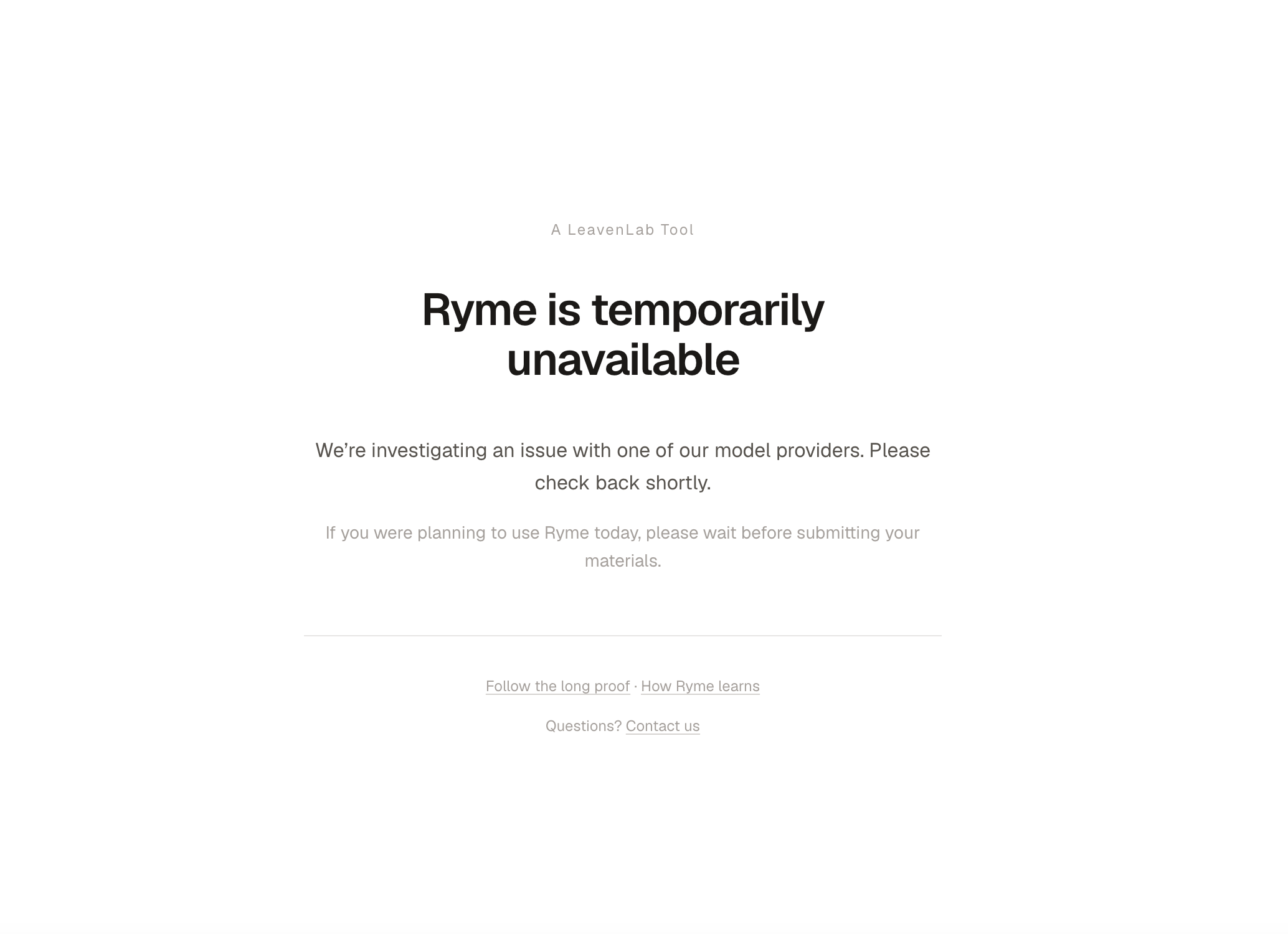
Once I knew Ryme could no longer complete its promise reliably, leaving it open would only ask founders to submit their materials, wait, and receive no useful result. The page explained that we had identified an issue with one of the models we use.
That transparency mattered to me.
A good product does not have to be available every second. But when it cannot reliably deliver, it should acknowledge the issue, avoid wasting the user’s time, and communicate clearly.
Further investigation showed that one of the models Ryme used had recently gone through a major rollout. Some of its default behavior had changed, causing requests to consume the full token budget and time out.
Even after I turned off the new default, the model did not behave exactly as it had before.
The application code had not changed. One of the systems underneath the product had.
Your code did not change. Your product did.
AI products do not run only inside their repositories. They also depend on model providers, infrastructure, defaults, hosting environments, and external services. Any of those systems can change independently.
This was also a reminder of where human judgment still matters. A coding agent can inspect the implementation and run repeated tests, but someone still has to recognize when the problem may sit outside the layer being investigated.
In this case, observability made the failure visible. Comparing the new build with an already validated production version moved the investigation beyond the code.
Model tuning is product maintenance
It is tempting to treat temperature, token limits, and timeout settings as one-time configuration work.
But model behavior is not static. A provider update can change how the same settings perform, and turning off a new default does not necessarily restore the behavior of an earlier version.
It requires ongoing testing, fallback planning, and the ability to change models or providers when their behavior shifts.
That work belongs on the product roadmap alongside visible features. It is part of whether the user receives the experience at all.
What remains valuable when building becomes easy
Vibe coding allowed me to put a working idea in front of founders within a few hours. That speed mattered because it helped me test whether the methodology had value beyond the conversations where it was originally developed.
But speed alone did not make Ryme a product.
The judgment crystallized inside the methodology created the value. The product made that judgment more accessible. Responsibility made that access trustworthy.
The method creates the value.
The product makes it accessible.
Responsibility makes it trustworthy.
As skills, templates, and prototypes become easier to build, the differentiator is not simply the ability to create another workflow. It is the ability to crystallize meaningful judgment within it—and to keep taking responsibility for how it works after it ships.